One sentence to a 60-second video: the StarCut workflow
Type one claim. The agent drafts script, shots, and a 60-second timeline you can still rewrite — not a locked MP4 from a black box.

Write a sentence the cut can obey
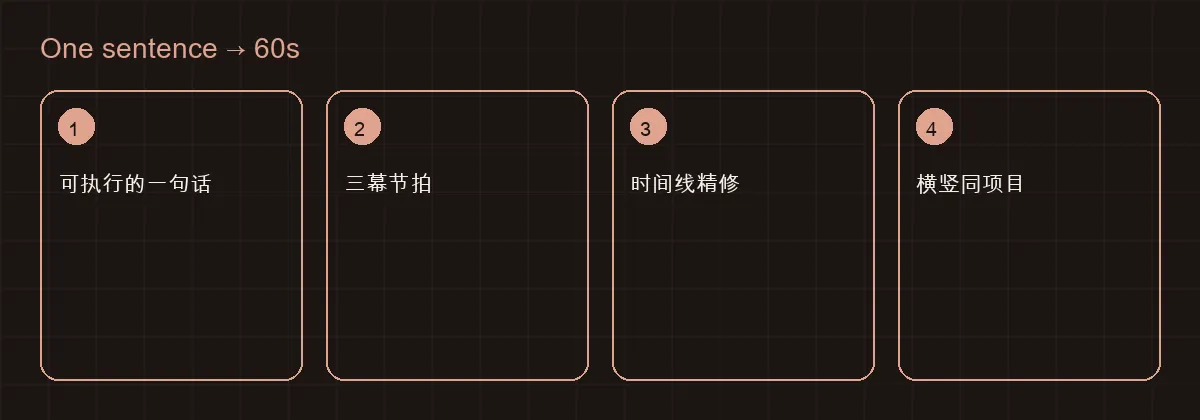
A useful one-liner names the audience, the promise, and the proof. “Show busy founders how our inbox triage saves ten minutes every morning” beats “make a cool launch video.” The first sentence constrains genre, footage, and CTA; the second invites vibes.
Length is part of the brief. Say you want about 60 seconds and whether the cut should feel like a story, a product demo, or a talking-head with B-roll. The agent cannot guess the genre from a mood adjective alone.
Add fixed strings when legal or brand requires them: exact product name casing, disclaimers, pricing that must not be improvised. Put those lines in quotes inside the prompt so the agent treats them as locked copy rather than creative clay.
What the agent should produce
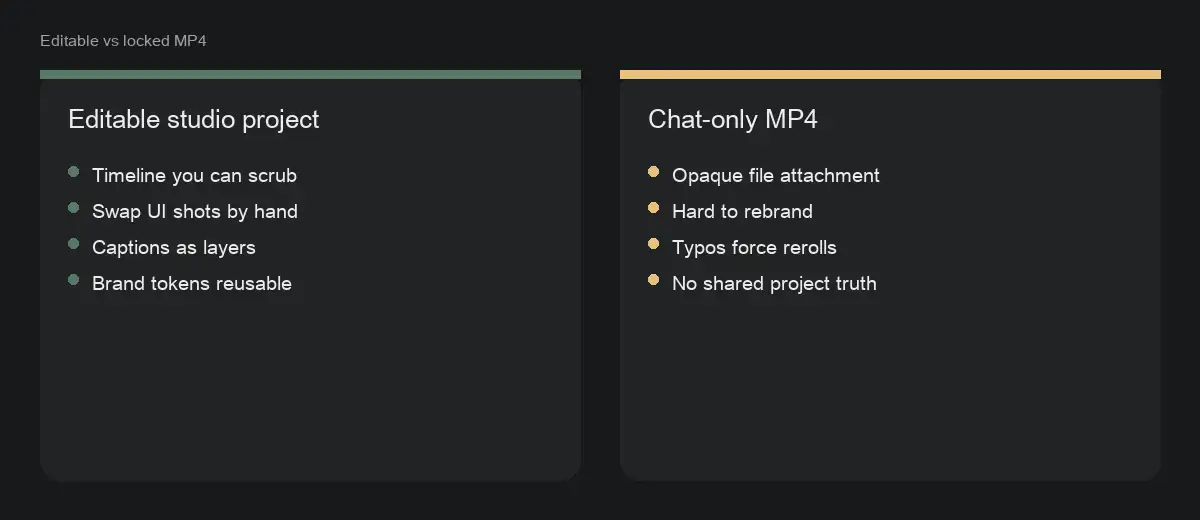
In StarCut, a one-sentence run should land a script, a shot plan, and timeline edits inside the open project. Voice, captions, and generated or selected B-roll belong on tracks you can mute, swap, or trim.
If the result is only a chat paragraph or a single file attachment, ask again for a studio cut — or open the project and confirm the agent used client-side tools. Pretty MP4s that you cannot open as a project are not the StarCut success path.
Expect a draft, not a sacred master. The economic win is how cheap the second and third revisions become once the cut already lives on a timeline you control.

Walkthrough: sentence → 60-second cut
Keep the first pass cheap to revise. You are aiming for a strong draft, not a final master on attempt one.
Watch the lease. Do not start a conflicting second run while the first still holds the project. Resume if the connection drops instead of branching histories.
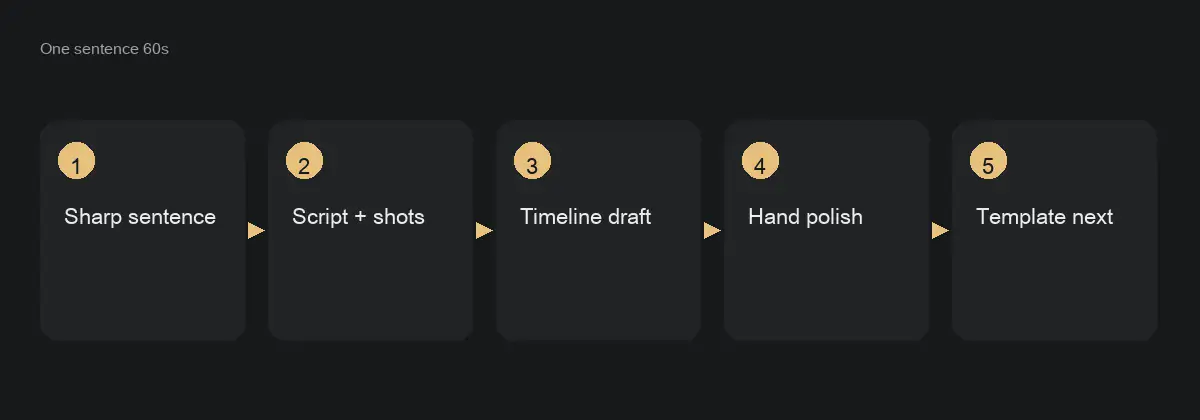
- Open a blank StarCut project or duplicate a branded template with type and end card already approved.
- Send one sentence plus constraints: “60 seconds, three beats, product UI if I upload it, captions on.”
- Upload any must-use screen recordings or logo assets into the project before or right after the first prompt.
- Watch the timeline populate with script, shots, voice, and captions — not only a chat summary.
- Pause or wait for the lease to free before requesting a conflicting pass.
- Rewrite weak lines of voice or title by hand. Replace any generated shot that misses the product.
- Tighten the opening two seconds so the claim lands before decorative motion.
- Export 16:9 and, if needed, duplicate for 9:16 with reframed safe areas.
- Save the polished project as the next launch template.
Three beats that fit sixty seconds
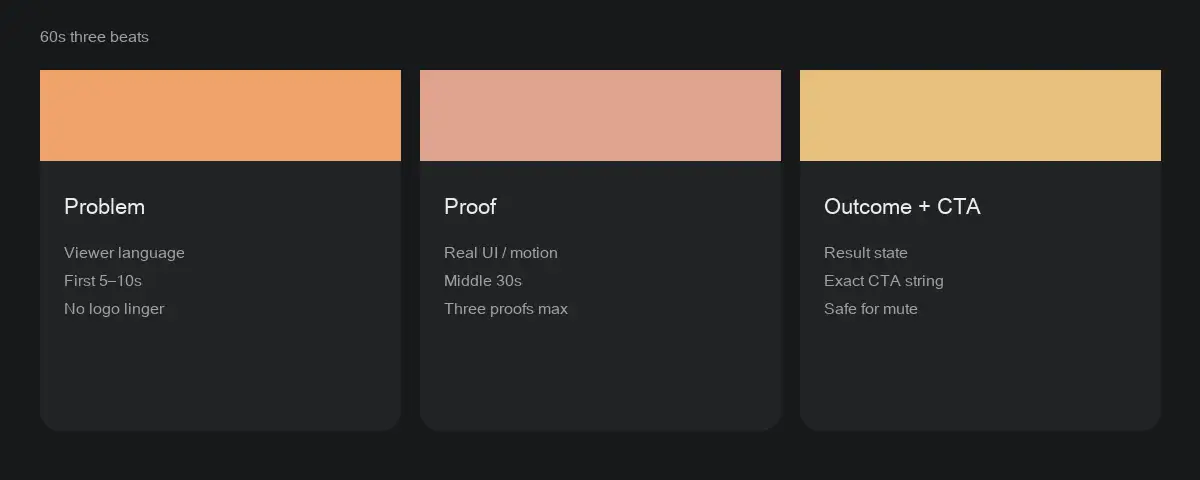
Most shippable 60-second films follow a compressed three-act map: problem in the viewer’s words, proof in motion, outcome plus CTA. If you cannot mark those beats on the timeline with your finger, the cut is probably a montage without an argument.
Story films can use character or metaphor, but still cash out in a concrete claim by second forty-five. Product films should show the product object — UI, device, package — early enough that viewers know what they are watching.
Music should support speech, not bury it. If the bed masks the VO, duck it on the timeline; do not regenerate the whole film to fix a mix problem.


Polish without regenerating everything
Most ship blockers are local: a soft open, a wrong UI screenshot, a caption typo, music that masks speech. Fix those on the timeline. Full regenerations are for when the story structure itself is wrong.
Save the finished project as a template when the brand system looks right. The next one-sentence launch should inherit type, end card, and pacing instead of starting from zero.
Version intentionally. Duplicate before a risky regenerate so you can compare A/B on the same brief without losing the better draft.

Related: make a product video with AI
One-sentence films vs text-to-video toys vs editors
Consumer text-to-video toys optimize for surprise. Marketing teams optimize for repeatable claims, brand systems, and editable masters. If you cannot change the CTA without rerolling the universe, you bought a novelty clip, not a workflow.
Traditional editors give control but demand a script, a shot list, and time. StarCut’s one-sentence path collapses the blank-page problem while keeping the control surface — the timeline — for the last mile.
When your “one sentence” is actually “cut highlights from this hour-long YouTube,” switch workflows. Highlight multi-clips start from a master, not from generative storyboards.
Long video → highlight multi-clips
When one sentence is not enough
Regulated claims, customer logos, and precise pricing need human-approved copy before generation. Put those lines in the brief as fixed text so the agent does not improvise legal language.
Complex multicam interviews are a different workflow — clip highlights from the master instead of asking a one-liner to invent the conversation.
If stakeholders disagree on the claim itself, stop generating. Alignment meetings are cheaper than five beautiful films that argue with each other in the ad account.
Why the cut belongs in the browser studio
Horizontal, vertical, and caption safety
Decide the primary placement before you fall in love with wide generative B-roll. A film designed only for 16:9 will lose faces and CTAs when naively cropped to 9:16.
Duplicate the finished horizontal sequence for vertical. Reframe, then move captions into the safe area. Export both with names that ops can find without opening the project.
Muted playback is the default on many feeds. If the film fails without sound, the captions or on-screen claim are not doing their job.
One sentence from Cursor, Claude, or ChatGPT
Supported hosts can send the same kind of brief through the StarCut plugin and MCP. The success check does not change: after the host finishes, open StarCut and edit the timeline.
Prefer host prompts that demand a studio project outcome. “Return an MP4 in chat” trains the wrong success metric. For desktop-native renders and code-driven bumpers, see the desktop client guide.
StarCut via ChatGPT, Claude, or Cursor
Example sentences that produce usable cuts
Strong: “In 60 seconds, show HR leads how our policy search answers employee questions before they open a ticket, using our real dashboard, then CTA to book a demo.” Weak: “Create an emotional brand film about the future of work.”
Strong story variant: “Tell a 60-second story of a night-owl founder who clears a buried inbox before standup, ending on our triage product shot and a free-trial CTA.” The product still appears; the metaphor does not replace proof.
Keep a swipe file of sentences that shipped. Future briefs start from winners, not from blank poetry.
Working with design and legal without killing speed
Send design the timeline, not only the MP4. They can swap UI frames without forcing another generative lottery.
Send legal the VO script and on-screen claims as text exports. Approve strings once, then lock them in the brief for variants.
Agree on a “no regenerate after brand lock” rule unless structure breaks. Most post-lock change requests are timeline edits.
Field manual: intake checklist for one-sentence 60-second films
Before any agent run for one-sentence 60-second films, confirm rights, master media, naming, and the success definition for the week. Teams skip this and then argue about outputs that never had a brief. Write the success definition as an observable: three platform-ready exports with cut IDs, not “make some viral stuff.”
Verify the project bin only contains media you are willing to ship. Scratch tracks, off-record jokes, and private slides must not sit next to public masters. Agents will not know the social contract of your green room.
Set loudness, aspect targets, and caption policy up front. Changing those after five drafts doubles work. The intake checklist is the cheapest quality control you will ever run.
Assign a human owner for the day. Shared ownership without a name produces duplicate exports and silent overwrites. Put the owner in the project title if you must.
Field manual: ranking and killing candidates for one-sentence 60-second films
Rank with a written rubric: hook clarity, context independence, brand risk, rights risk, and strategic fit for the week’s theme. Score lightly — 1 to 5 — so debates stay numeric instead of vibes-only.
Kill generously. A longlist of twenty is a planning artifact; a shortlist of three is a shipping plan. Agents can propose many; humans must cull.
Record why something died. Without reasons, the same bad candidate returns next week wearing a new haircut.
Revisit the rubric monthly using analytics. If story turns outperform hot takes, stop pretending your taste is the audience.
Field manual: timeline build standards for one-sentence 60-second films
Every accepted candidate becomes a timeline cut with voice/captions/titles as needed — not a paragraph in chat. If the editor tracks do not change, the run failed.
Endings get extra scrutiny. Bad endings create swipe training. Watch the last two seconds muted and with sound.
Brand kit always on. One-off styling for a single clip taxes the season’s recognizability.
Export naming includes date, theme, and cut ID. Pretty names that mean nothing are how ads accounts drown.

Field manual: QA and publish for one-sentence 60-second films
QA is a gate, not a vibe. Names, rights, safe areas, loudness, disclosures, and CTA correctness get explicit checks. Then publish with analytics tags already attached.
Schedule intentionally. Dumping five clips in an hour trains platforms and humans to ignore you. Spread posts unless you are running an event-driven blitz with a reason.
After publish, monitor the first three hours for wrong aspect, broken links, or emerging context that changes meaning. Keep a takedown owner awake or on-call for newsy topics.
Write aftercare notes the same day. Future ranking depends on present documentation.
Field manual: learning loop for one-sentence 60-second films
Weekly: compare shipped cut IDs against completion and follow/save metrics. Promote patterns into the rubric and prompt library. Demote ego favorites that fail.
Monthly: refresh templates and kill unused experiments in the bin. Clutter is a tax on every future agent pass.
Quarterly: revisit tool boundaries. Maybe you need more desktop muscle, more MCP automation, or fewer platforms. Strategy should change with evidence, not with boredom.
Teach newcomers with annotated winners and losers. Culture is what you show, not what you slogan.
Field manual: collaboration with agents without losing taste for one-sentence 60-second films
Agents draft; humans decide endings, claims, and ethics. If you reverse that, you get fluent mediocrity at scale.
Speak in constraints and observables. “More premium” is not a constraint. “Use brand kit, 9:16 safe captions, end on resolved beat under 35s” is.
Keep a diff mindset. Prefer surgical timeline edits over full regenerations that wipe polish.
Log prompts that shipped. Prompt folklore dies when people leave; prompt libraries survive.
Field manual: rights, safety, and reputation for one-sentence 60-second films
Rights are not a footer. Music, guests, footage, and trademarks each need a yes. Ambiguity means no for public shipping.
Safety includes psychological safety of subjects and audiences. Out-of-context cuts can harm even when literally accurate.
Reputation compounds. One careless viral clip can outweigh a year of careful longform. Treat ranking risk as seriously as retention upside.
When unsure, delay. Speed is a feature until it becomes a liability with a date stamp.
Field manual: scaling one-sentence 60-second films from one producer to a pod
Document before you hire. If the system lives in one person’s head, hiring multiplies chaos. Write the rubric, the prompts, the QA gate, and the calendar.
Specialize: one person ranks, one builds, one QAs, rotating weekly if the pod is small. Rotation builds empathy and prevents bottleneck heroics.
Shared project hygiene rules beat private folders. Private folders become shadow canons.
Measure pod throughput as shipped-quality cut IDs per week, not hours spent chatting with agents.
Ops Clock
Use timed working blocks, written anti-patterns, stakeholder packets with A/B decisions, and explicit tool boundaries so agents accelerate craft instead of amplifying chaos.
Keep examples linked from the project template. Abstract rules without samples decay into posters nobody follows.
Review boundaries quarterly. When exceptions become frequent, update the doc rather than normalizing silent rule-breaking.
Ship fewer, better, measurable cut IDs. Throughput without learning is only motion.
Define a minimum shippable bar before polish. Safety and rights are not decorations; they are the floor.
Track narrative debt created by hooks that imply sequels or promises, and repay it with series planning or clear descriptions.
Treat captions as reading UX first and decoration second; fix proper nouns before burn-in.
Distribute in thematic clusters with deliberate spacing, and keep cut-ID prefixes distinct for paid vs organic.
Anti Patterns
Use timed working blocks, written anti-patterns, stakeholder packets with A/B decisions, and explicit tool boundaries so agents accelerate craft instead of amplifying chaos.
Keep examples linked from the project template. Abstract rules without samples decay into posters nobody follows.
Review boundaries quarterly. When exceptions become frequent, update the doc rather than normalizing silent rule-breaking.
Ship fewer, better, measurable cut IDs. Throughput without learning is only motion.
Define a minimum shippable bar before polish. Safety and rights are not decorations; they are the floor.
Track narrative debt created by hooks that imply sequels or promises, and repay it with series planning or clear descriptions.
Treat captions as reading UX first and decoration second; fix proper nouns before burn-in.
Distribute in thematic clusters with deliberate spacing, and keep cut-ID prefixes distinct for paid vs organic.
Stakeholder Pack
Use timed working blocks, written anti-patterns, stakeholder packets with A/B decisions, and explicit tool boundaries so agents accelerate craft instead of amplifying chaos.
Keep examples linked from the project template. Abstract rules without samples decay into posters nobody follows.
Review boundaries quarterly. When exceptions become frequent, update the doc rather than normalizing silent rule-breaking.
Ship fewer, better, measurable cut IDs. Throughput without learning is only motion.
Define a minimum shippable bar before polish. Safety and rights are not decorations; they are the floor.
Track narrative debt created by hooks that imply sequels or promises, and repay it with series planning or clear descriptions.
Treat captions as reading UX first and decoration second; fix proper nouns before burn-in.
Distribute in thematic clusters with deliberate spacing, and keep cut-ID prefixes distinct for paid vs organic.
Tooling Boundary
Use timed working blocks, written anti-patterns, stakeholder packets with A/B decisions, and explicit tool boundaries so agents accelerate craft instead of amplifying chaos.
Keep examples linked from the project template. Abstract rules without samples decay into posters nobody follows.
Review boundaries quarterly. When exceptions become frequent, update the doc rather than normalizing silent rule-breaking.
Ship fewer, better, measurable cut IDs. Throughput without learning is only motion.
Define a minimum shippable bar before polish. Safety and rights are not decorations; they are the floor.
Track narrative debt created by hooks that imply sequels or promises, and repay it with series planning or clear descriptions.
Treat captions as reading UX first and decoration second; fix proper nouns before burn-in.
Distribute in thematic clusters with deliberate spacing, and keep cut-ID prefixes distinct for paid vs organic.
Quality Bar
Use timed working blocks, written anti-patterns, stakeholder packets with A/B decisions, and explicit tool boundaries so agents accelerate craft instead of amplifying chaos.
Keep examples linked from the project template. Abstract rules without samples decay into posters nobody follows.
Review boundaries quarterly. When exceptions become frequent, update the doc rather than normalizing silent rule-breaking.
Ship fewer, better, measurable cut IDs. Throughput without learning is only motion.
Define a minimum shippable bar before polish. Safety and rights are not decorations; they are the floor.
Track narrative debt created by hooks that imply sequels or promises, and repay it with series planning or clear descriptions.
Treat captions as reading UX first and decoration second; fix proper nouns before burn-in.
Distribute in thematic clusters with deliberate spacing, and keep cut-ID prefixes distinct for paid vs organic.
Narrative Debt
Use timed working blocks, written anti-patterns, stakeholder packets with A/B decisions, and explicit tool boundaries so agents accelerate craft instead of amplifying chaos.
Keep examples linked from the project template. Abstract rules without samples decay into posters nobody follows.
Review boundaries quarterly. When exceptions become frequent, update the doc rather than normalizing silent rule-breaking.
Ship fewer, better, measurable cut IDs. Throughput without learning is only motion.
Define a minimum shippable bar before polish. Safety and rights are not decorations; they are the floor.
Track narrative debt created by hooks that imply sequels or promises, and repay it with series planning or clear descriptions.
Treat captions as reading UX first and decoration second; fix proper nouns before burn-in.
Distribute in thematic clusters with deliberate spacing, and keep cut-ID prefixes distinct for paid vs organic.
Caption Craft
Use timed working blocks, written anti-patterns, stakeholder packets with A/B decisions, and explicit tool boundaries so agents accelerate craft instead of amplifying chaos.
Keep examples linked from the project template. Abstract rules without samples decay into posters nobody follows.
Review boundaries quarterly. When exceptions become frequent, update the doc rather than normalizing silent rule-breaking.
Ship fewer, better, measurable cut IDs. Throughput without learning is only motion.
Define a minimum shippable bar before polish. Safety and rights are not decorations; they are the floor.
Track narrative debt created by hooks that imply sequels or promises, and repay it with series planning or clear descriptions.
Treat captions as reading UX first and decoration second; fix proper nouns before burn-in.
Distribute in thematic clusters with deliberate spacing, and keep cut-ID prefixes distinct for paid vs organic.
Distribution Math
Use timed working blocks, written anti-patterns, stakeholder packets with A/B decisions, and explicit tool boundaries so agents accelerate craft instead of amplifying chaos.
Keep examples linked from the project template. Abstract rules without samples decay into posters nobody follows.
Review boundaries quarterly. When exceptions become frequent, update the doc rather than normalizing silent rule-breaking.
Ship fewer, better, measurable cut IDs. Throughput without learning is only motion.
Define a minimum shippable bar before polish. Safety and rights are not decorations; they are the floor.
Track narrative debt created by hooks that imply sequels or promises, and repay it with series planning or clear descriptions.
Treat captions as reading UX first and decoration second; fix proper nouns before burn-in.
Distribute in thematic clusters with deliberate spacing, and keep cut-ID prefixes distinct for paid vs organic.
Library Hygiene
Use timed working blocks, written anti-patterns, stakeholder packets with A/B decisions, and explicit tool boundaries so agents accelerate craft instead of amplifying chaos.
Keep examples linked from the project template. Abstract rules without samples decay into posters nobody follows.
Review boundaries quarterly. When exceptions become frequent, update the doc rather than normalizing silent rule-breaking.
Ship fewer, better, measurable cut IDs. Throughput without learning is only motion.
Define a minimum shippable bar before polish. Safety and rights are not decorations; they are the floor.
Track narrative debt created by hooks that imply sequels or promises, and repay it with series planning or clear descriptions.
Treat captions as reading UX first and decoration second; fix proper nouns before burn-in.
Distribute in thematic clusters with deliberate spacing, and keep cut-ID prefixes distinct for paid vs organic.
Editor Taste
Use timed working blocks, written anti-patterns, stakeholder packets with A/B decisions, and explicit tool boundaries so agents accelerate craft instead of amplifying chaos.
Keep examples linked from the project template. Abstract rules without samples decay into posters nobody follows.
Review boundaries quarterly. When exceptions become frequent, update the doc rather than normalizing silent rule-breaking.
Ship fewer, better, measurable cut IDs. Throughput without learning is only motion.
Define a minimum shippable bar before polish. Safety and rights are not decorations; they are the floor.
Track narrative debt created by hooks that imply sequels or promises, and repay it with series planning or clear descriptions.
Treat captions as reading UX first and decoration second; fix proper nouns before burn-in.
Distribute in thematic clusters with deliberate spacing, and keep cut-ID prefixes distinct for paid vs organic.
Incident Runbook
Use timed working blocks, written anti-patterns, stakeholder packets with A/B decisions, and explicit tool boundaries so agents accelerate craft instead of amplifying chaos.
Keep examples linked from the project template. Abstract rules without samples decay into posters nobody follows.
Review boundaries quarterly. When exceptions become frequent, update the doc rather than normalizing silent rule-breaking.
Ship fewer, better, measurable cut IDs. Throughput without learning is only motion.
Define a minimum shippable bar before polish. Safety and rights are not decorations; they are the floor.
Track narrative debt created by hooks that imply sequels or promises, and repay it with series planning or clear descriptions.
Treat captions as reading UX first and decoration second; fix proper nouns before burn-in.
Distribute in thematic clusters with deliberate spacing, and keep cut-ID prefixes distinct for paid vs organic.
Sentence QA before you spend a single agent minute
Ask: who is this for, what proof will appear, what must they do at the end, and what must not be claimed. If any answer is mush, rewrite the sentence.
Count syllables or characters against spoken time. A gorgeous sentence that cannot be spoken in eight seconds of hook is a poster, not a brief.
Store winning sentences with their cut IDs. Your future library of briefs is a growth asset.
One sentence is enough to start — an editable timeline is what makes the result shippable.
Questions
Is this text-to-video with no timeline?
No. StarCut aims for an editable project: script, shots, captions, and voice on a timeline you can revise after the run.
Can I upload my own product UI?
Yes. Add screen recordings before or after the first draft and swap generated placeholders on the timeline.
How long should the sentence be?
One clear claim plus audience and proof. If you need a paragraph of constraints, that is still fine — “one sentence” means one idea, not a hard character limit.
What if the first draft is off-brand?
Change type, color, and lines on the timeline. Regenerate only when the story beats themselves are wrong.
Can I make variants for different audiences?
Yes. Duplicate the project, change the sentence and CTA, and reuse the brand template so variants stay visually related.
How many credits does a 60-second run use?
Generation steps show cost before they run. Timeline polish — trims, caption edits, reframes — is normal studio work.
Should music be generated every time?
Not if you have an approved bed. Drop the licensed bed on the timeline and duck under speech instead of regenerating music for every launch.
What if stakeholders want a different ending?
Duplicate the sequence and revise the final beat and CTA on the timeline. Avoid regenerating the whole film for an ending swap.
Can one sentence drive a series of weekly films?
Yes — keep the brand template and swap the sentence plus proof assets each week. Consistency compounds faster than novelty.
What aspect ratio should I generate first?
Generate for the primary spend placement first, then duplicate and reframe. Do not treat crop-as-afterthought as a strategy.
What is the first hire for scaling one-sentence 60-second films?
A producer who can own QA and calendar — not another person who only chats with agents.
How do we keep quality when speeding up?
Freeze rubric and brand kit; speed inside constraints. Unbounded speed is just churn.
Should every experiment ship publicly?
No. Separate experiment projects from ship projects with watermarks and different cut ID prefixes.
How long should aftercare notes be?
Five lines beat five pages. Cut ID, what changed, metric movement, next hypothesis, owner.
When do we redesign templates?
On season boundaries or clear fatigue in analytics — not because someone saw a trendy transition.
What is narrative debt?
Implied sequels or promises a short creates; repay with follow-ups or clear copy, or avoid high-debt hooks.
How do we separate experiments from shipping?
Different projects, watermarks, and cut-ID prefixes. Never let experiments silently become the public canon.
What belongs in a stakeholder packet?
Audience, metric, theme, shortlist, risks, and A/B decisions with timecodes — not a mood check.
Can marketing adjectives stay in the sentence?
Only if they map to visible proof in the cut. Otherwise they become empty voice-over.