StarCut desktop client: text AI that writes code to render video
The desktop shell keeps StarCut in sync with the web studio while unlocking native speed — and lets coding agents write the render path instead of only chatting about cuts.
Why a desktop client, if the studio already runs in the browser
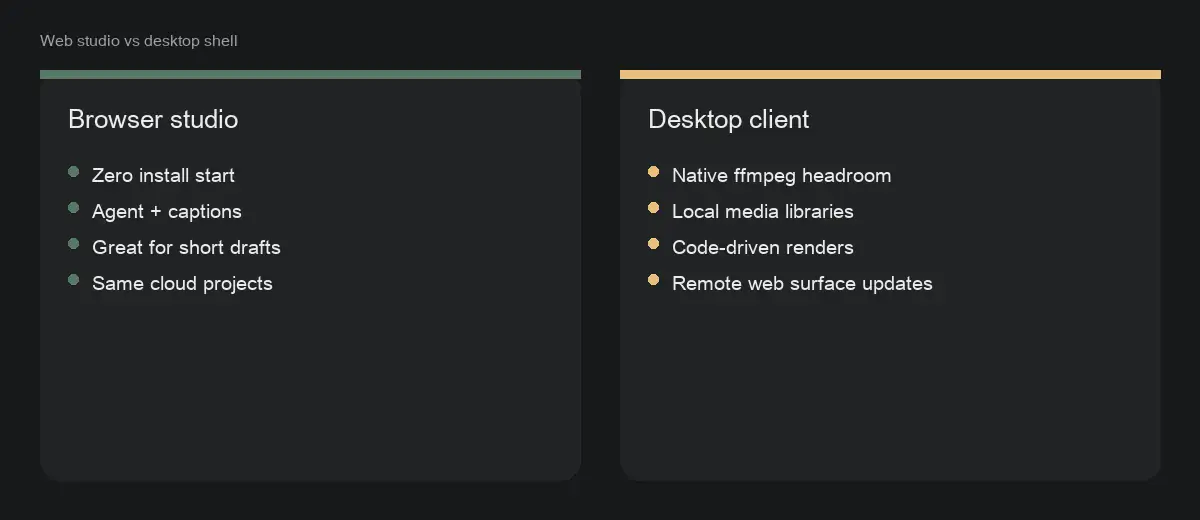
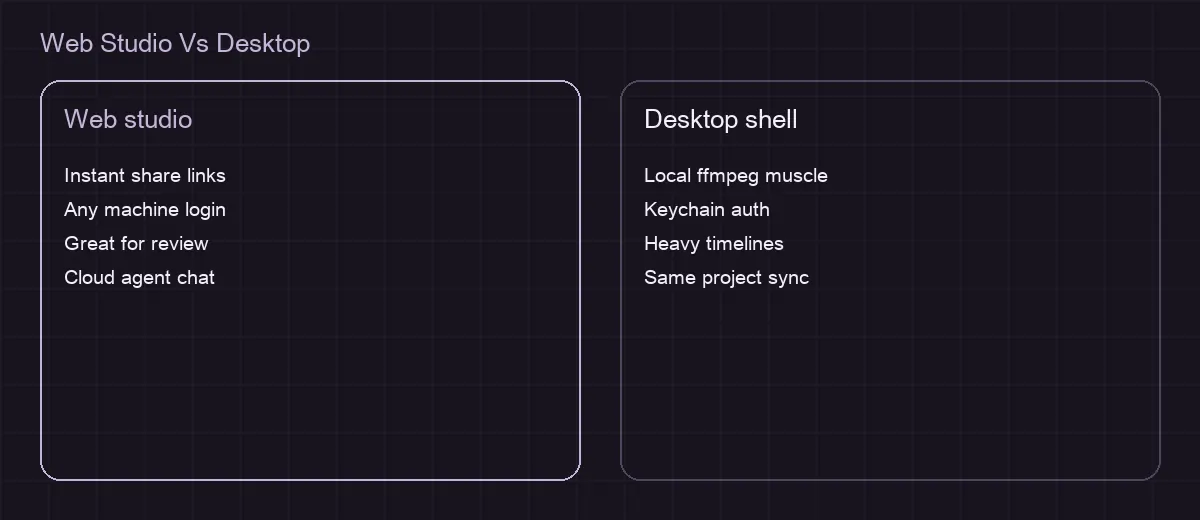
Browser StarCut is enough to start: agent, timeline, captions, and collaboration without an installer. Heavy timelines, local media libraries, and long renders still benefit from a native shell — ffmpeg on the metal, fewer tab freezes, and access to files that never needed a full re-upload.
The product rule is consistency. The desktop client should open the same projects you already use on studio.starcut.io, not fork a second timeline format. Updates to the web studio should reach the shell without waiting for a full app store resubmit when only the web surface changed.
Think of desktop as a performance and filesystem tier, not a separate product line. If a cut only exists as a local-only file the web cannot open, the client drifted from the rule that keeps teams sane.
Text AI that writes code to render video
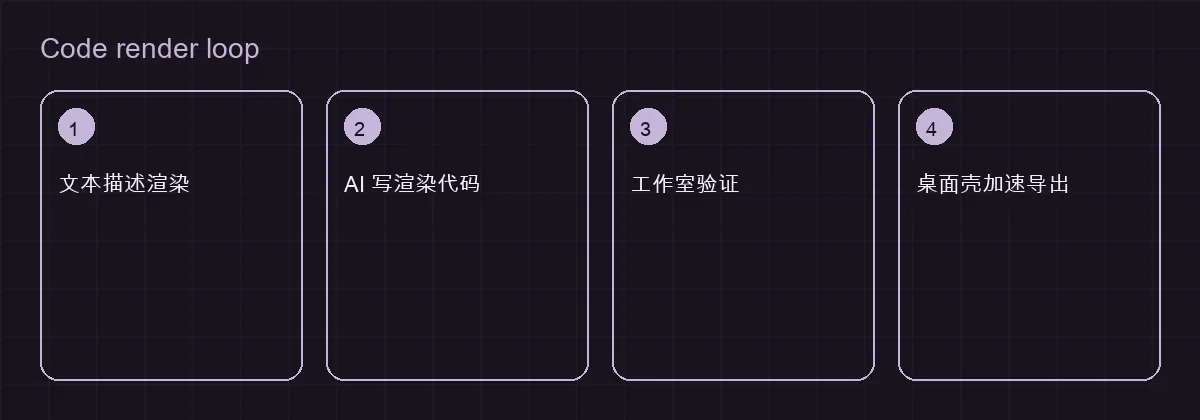
Some cuts are easier to describe as a program than as a pile of manual keyframes: data-driven lower thirds, parameterized transitions, batch variants for every locale. On the desktop path, a coding-capable agent can write render code against the open project — then leave results on the timeline you still scrub in the studio.
That is different from a chat model that only returns an MP4. The check stays familiar: after the agent stops, open the project, inspect the generated assets or composition, and change one parameter by hand. If you cannot, the run did not use StarCut.
Code render shines when the same bumper must ship in twelve languages or forty partner logos. Parameters beat reshoots. Keep the template project; change the JSON or text slots; re-render.

Walkthrough: describe the render, verify in the studio
Use a brief you can validate visually — a 15-second bumper with a title, logo lockup, and two locale variants is enough to prove the loop.
Refuse chat-only success. If the host or agent celebrates an MP4 attachment but the project is unchanged, ask again for a studio-bound render.
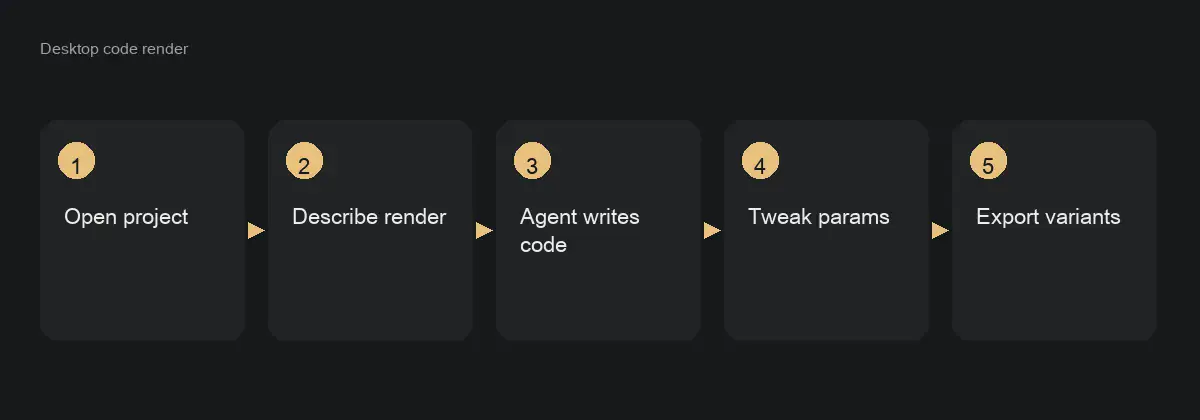
- Open the project in StarCut (web today; desktop client when your build is available).
- Ask for a concrete render: duration, assets to bind, text slots, and output aspect ratios.
- Let the coding agent write and run the render path against that project rather than “make me a video file in chat.”
- Inspect the timeline or generated composition. Change one title string or color token by hand.
- Re-run only the parameterized step for a second locale instead of rebuilding the whole bumper.
- Export only after the parameters look right. Keep the project so the next variant is a parameter change, not a reshoot.
- Commit or snapshot the project when the brand system is approved so agents do not drift tokens next week.
- Document which host prompt produced the good run so teammates can repeat it.
Use StarCut from Cursor, Codex, and Claude Code
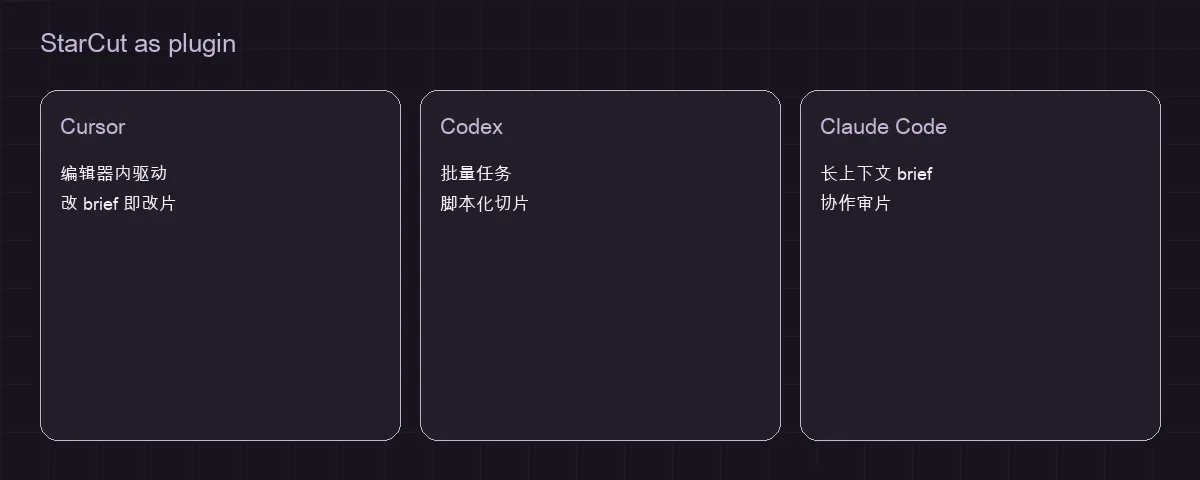
StarCut installs as a plugin / MCP skill on supported coding hosts. Cursor, Codex, Claude Code, and the other hosts on the plugin page can drive the same kind of project you open in the browser or desktop shell.
Copy the host-specific install prompt from the plugin page. Do not invent a generic MCP snippet — wiring differs per host. After the host runs, verify in StarCut that the timeline or render outputs are editable.
Coding hosts are strongest when the task is already structured: bind these assets, fill these slots, export these ratios. Soft “make it cinematic” prompts waste the advantage of a code-capable agent.



Web studio and desktop shell together
Day-to-day drafting can stay in the browser. Move to the desktop client when local media, longer timelines, or code-driven renders need native headroom. Both should point at the same account and projects.
For agent behavior inside the client — leases, resume, and taking the timeline back — see the client-side agent tools guide. For host install details, see the MCP guide for ChatGPT, Claude, and Cursor.
Remote-loading shells (web UI inside a native wrapper) keep feature parity high: when studio.starcut.io ships a fix, the desktop door shows it without a full binary release. Native modules still version separately when ffmpeg tooling or OS integrations change.

StarCut via ChatGPT, Claude, or Cursor
When performance actually matters
Not every cut needs desktop. A 45-second product explainer with a handful of screen recordings is usually fine in the browser. Desktop helps when scrubbing stutters, when local camera cards are huge, or when batch renders would keep a laptop fan screaming inside a browser sandbox.
Measure the pain: export time, scrub responsiveness, and how often you re-upload the same masters. If those metrics dominate your week, the shell is for you; if not, stay on web and invest in clearer briefs instead.
Collaboration still centers on the shared project. Desktop does not mean “offline forever” — it means native execution against the same source of truth your teammates open in a tab.
Desktop code render vs black-box generators vs traditional AE pipelines
Black-box generators are fast for one-off novelty. They fail when you need a parameterized brand system and an editable afterlife. Traditional After Effects pipelines are powerful and slow to staff. StarCut’s code-render path aims at the middle: agent-written parameters, studio-visible results.
You still need craft. Bad briefs produce bad programs. The difference is that fixing a title slot should not require reopening a 4GB project file you are afraid to touch.
If your need is simply “one sentence → 60s story film,” start with that workflow in the web studio. Bring desktop in when the same idea becomes a multi-locale render farm.
One sentence → 60-second video
Credentials, local files, and agent scope
Desktop shells often hold keychain sessions and local paths. Treat agent permissions like you would a CI token: least privilege, clear project scope, and no silent uploads of directories the brief did not name.
When a coding host drives StarCut, keep secrets in the host’s secret store or StarCut’s account model — not pasted into chat. Prompt logs are not a vault.
For team policies, decide which machines may run code render and which projects are production-branded. A laptop experiment should not silently overwrite the template everyone else duplicates.
What “client launching soon” means for you today
You can — and should — build habits on the web studio now: briefs that name claims, projects that hold masters, timelines you polish by hand. Those habits transfer when the desktop build lands for your platform.
Watch for download builds and release notes that call out native modules versus remote web surface updates. Knowing which layer changed prevents false bugs when only the wrapper bumped.
If you already use Cursor or Claude Code daily, install the StarCut plugin early so the team’s prompts mature before desktop performance arrives.
Rolling desktop out to a team
Start with editors who hit browser limits weekly — long timelines, local camera cards, batch locale renders. Do not force the whole company onto a binary on day one.
Document which projects are “web fine” versus “desktop preferred.” Ambiguity creates duplicate work and conflicting exports.
Train on the verification habit: after any agent or host run, change one parameter on the timeline. That habit matters more than which shell you used.
Where code render is going next
Expect tighter loops between coding hosts and the studio: propose code, preview in-project, commit parameters, export variants. The chat transcript should not be the system of record.
Brand kits as code — tokens, slots, approved motion — will matter more than one-off prompts. Teams that invest in parameterized templates will outrun teams that only collect MP4s.
Keep reading the MCP and client-side agent guides as hosts evolve; install prompts change even when the project model stays stable.
Field manual: intake checklist for desktop client + AI code-render video
Before any agent run for desktop client + AI code-render video, confirm rights, master media, naming, and the success definition for the week. Teams skip this and then argue about outputs that never had a brief. Write the success definition as an observable: three platform-ready exports with cut IDs, not “make some viral stuff.”
Verify the project bin only contains media you are willing to ship. Scratch tracks, off-record jokes, and private slides must not sit next to public masters. Agents will not know the social contract of your green room.
Set loudness, aspect targets, and caption policy up front. Changing those after five drafts doubles work. The intake checklist is the cheapest quality control you will ever run.
Assign a human owner for the day. Shared ownership without a name produces duplicate exports and silent overwrites. Put the owner in the project title if you must.
Field manual: ranking and killing candidates for desktop client + AI code-render video
Rank with a written rubric: hook clarity, context independence, brand risk, rights risk, and strategic fit for the week’s theme. Score lightly — 1 to 5 — so debates stay numeric instead of vibes-only.
Kill generously. A longlist of twenty is a planning artifact; a shortlist of three is a shipping plan. Agents can propose many; humans must cull.
Record why something died. Without reasons, the same bad candidate returns next week wearing a new haircut.
Revisit the rubric monthly using analytics. If story turns outperform hot takes, stop pretending your taste is the audience.
Field manual: timeline build standards for desktop client + AI code-render video
Every accepted candidate becomes a timeline cut with voice/captions/titles as needed — not a paragraph in chat. If the editor tracks do not change, the run failed.
Endings get extra scrutiny. Bad endings create swipe training. Watch the last two seconds muted and with sound.
Brand kit always on. One-off styling for a single clip taxes the season’s recognizability.
Export naming includes date, theme, and cut ID. Pretty names that mean nothing are how ads accounts drown.
Field manual: QA and publish for desktop client + AI code-render video
QA is a gate, not a vibe. Names, rights, safe areas, loudness, disclosures, and CTA correctness get explicit checks. Then publish with analytics tags already attached.
Schedule intentionally. Dumping five clips in an hour trains platforms and humans to ignore you. Spread posts unless you are running an event-driven blitz with a reason.
After publish, monitor the first three hours for wrong aspect, broken links, or emerging context that changes meaning. Keep a takedown owner awake or on-call for newsy topics.
Write aftercare notes the same day. Future ranking depends on present documentation.
Field manual: learning loop for desktop client + AI code-render video
Weekly: compare shipped cut IDs against completion and follow/save metrics. Promote patterns into the rubric and prompt library. Demote ego favorites that fail.
Monthly: refresh templates and kill unused experiments in the bin. Clutter is a tax on every future agent pass.
Quarterly: revisit tool boundaries. Maybe you need more desktop muscle, more MCP automation, or fewer platforms. Strategy should change with evidence, not with boredom.
Teach newcomers with annotated winners and losers. Culture is what you show, not what you slogan.
Field manual: collaboration with agents without losing taste for desktop client + AI code-render video
Agents draft; humans decide endings, claims, and ethics. If you reverse that, you get fluent mediocrity at scale.
Speak in constraints and observables. “More premium” is not a constraint. “Use brand kit, 9:16 safe captions, end on resolved beat under 35s” is.
Keep a diff mindset. Prefer surgical timeline edits over full regenerations that wipe polish.
Log prompts that shipped. Prompt folklore dies when people leave; prompt libraries survive.
Field manual: rights, safety, and reputation for desktop client + AI code-render video
Rights are not a footer. Music, guests, footage, and trademarks each need a yes. Ambiguity means no for public shipping.
Safety includes psychological safety of subjects and audiences. Out-of-context cuts can harm even when literally accurate.
Reputation compounds. One careless viral clip can outweigh a year of careful longform. Treat ranking risk as seriously as retention upside.
When unsure, delay. Speed is a feature until it becomes a liability with a date stamp.
Field manual: scaling desktop client + AI code-render video from one producer to a pod
Document before you hire. If the system lives in one person’s head, hiring multiplies chaos. Write the rubric, the prompts, the QA gate, and the calendar.
Specialize: one person ranks, one builds, one QAs, rotating weekly if the pod is small. Rotation builds empathy and prevents bottleneck heroics.
Shared project hygiene rules beat private folders. Private folders become shadow canons.
Measure pod throughput as shipped-quality cut IDs per week, not hours spent chatting with agents.
Ops Clock
Use timed working blocks, written anti-patterns, stakeholder packets with A/B decisions, and explicit tool boundaries so agents accelerate craft instead of amplifying chaos.
Keep examples linked from the project template. Abstract rules without samples decay into posters nobody follows.
Review boundaries quarterly. When exceptions become frequent, update the doc rather than normalizing silent rule-breaking.
Ship fewer, better, measurable cut IDs. Throughput without learning is only motion.
Define a minimum shippable bar before polish. Safety and rights are not decorations; they are the floor.
Track narrative debt created by hooks that imply sequels or promises, and repay it with series planning or clear descriptions.
Treat captions as reading UX first and decoration second; fix proper nouns before burn-in.
Distribute in thematic clusters with deliberate spacing, and keep cut-ID prefixes distinct for paid vs organic.
Anti Patterns
Use timed working blocks, written anti-patterns, stakeholder packets with A/B decisions, and explicit tool boundaries so agents accelerate craft instead of amplifying chaos.
Keep examples linked from the project template. Abstract rules without samples decay into posters nobody follows.
Review boundaries quarterly. When exceptions become frequent, update the doc rather than normalizing silent rule-breaking.
Ship fewer, better, measurable cut IDs. Throughput without learning is only motion.
Define a minimum shippable bar before polish. Safety and rights are not decorations; they are the floor.
Track narrative debt created by hooks that imply sequels or promises, and repay it with series planning or clear descriptions.
Treat captions as reading UX first and decoration second; fix proper nouns before burn-in.
Distribute in thematic clusters with deliberate spacing, and keep cut-ID prefixes distinct for paid vs organic.
Stakeholder Pack
Use timed working blocks, written anti-patterns, stakeholder packets with A/B decisions, and explicit tool boundaries so agents accelerate craft instead of amplifying chaos.
Keep examples linked from the project template. Abstract rules without samples decay into posters nobody follows.
Review boundaries quarterly. When exceptions become frequent, update the doc rather than normalizing silent rule-breaking.
Ship fewer, better, measurable cut IDs. Throughput without learning is only motion.
Define a minimum shippable bar before polish. Safety and rights are not decorations; they are the floor.
Track narrative debt created by hooks that imply sequels or promises, and repay it with series planning or clear descriptions.
Treat captions as reading UX first and decoration second; fix proper nouns before burn-in.
Distribute in thematic clusters with deliberate spacing, and keep cut-ID prefixes distinct for paid vs organic.
Tooling Boundary
Use timed working blocks, written anti-patterns, stakeholder packets with A/B decisions, and explicit tool boundaries so agents accelerate craft instead of amplifying chaos.
Keep examples linked from the project template. Abstract rules without samples decay into posters nobody follows.
Review boundaries quarterly. When exceptions become frequent, update the doc rather than normalizing silent rule-breaking.
Ship fewer, better, measurable cut IDs. Throughput without learning is only motion.
Define a minimum shippable bar before polish. Safety and rights are not decorations; they are the floor.
Track narrative debt created by hooks that imply sequels or promises, and repay it with series planning or clear descriptions.
Treat captions as reading UX first and decoration second; fix proper nouns before burn-in.
Distribute in thematic clusters with deliberate spacing, and keep cut-ID prefixes distinct for paid vs organic.
Quality Bar
Use timed working blocks, written anti-patterns, stakeholder packets with A/B decisions, and explicit tool boundaries so agents accelerate craft instead of amplifying chaos.
Keep examples linked from the project template. Abstract rules without samples decay into posters nobody follows.
Review boundaries quarterly. When exceptions become frequent, update the doc rather than normalizing silent rule-breaking.
Ship fewer, better, measurable cut IDs. Throughput without learning is only motion.
Define a minimum shippable bar before polish. Safety and rights are not decorations; they are the floor.
Track narrative debt created by hooks that imply sequels or promises, and repay it with series planning or clear descriptions.
Treat captions as reading UX first and decoration second; fix proper nouns before burn-in.
Distribute in thematic clusters with deliberate spacing, and keep cut-ID prefixes distinct for paid vs organic.
Narrative Debt
Use timed working blocks, written anti-patterns, stakeholder packets with A/B decisions, and explicit tool boundaries so agents accelerate craft instead of amplifying chaos.
Keep examples linked from the project template. Abstract rules without samples decay into posters nobody follows.
Review boundaries quarterly. When exceptions become frequent, update the doc rather than normalizing silent rule-breaking.
Ship fewer, better, measurable cut IDs. Throughput without learning is only motion.
Define a minimum shippable bar before polish. Safety and rights are not decorations; they are the floor.
Track narrative debt created by hooks that imply sequels or promises, and repay it with series planning or clear descriptions.
Treat captions as reading UX first and decoration second; fix proper nouns before burn-in.
Distribute in thematic clusters with deliberate spacing, and keep cut-ID prefixes distinct for paid vs organic.
Caption Craft
Use timed working blocks, written anti-patterns, stakeholder packets with A/B decisions, and explicit tool boundaries so agents accelerate craft instead of amplifying chaos.
Keep examples linked from the project template. Abstract rules without samples decay into posters nobody follows.
Review boundaries quarterly. When exceptions become frequent, update the doc rather than normalizing silent rule-breaking.
Ship fewer, better, measurable cut IDs. Throughput without learning is only motion.
Define a minimum shippable bar before polish. Safety and rights are not decorations; they are the floor.
Track narrative debt created by hooks that imply sequels or promises, and repay it with series planning or clear descriptions.
Treat captions as reading UX first and decoration second; fix proper nouns before burn-in.
Distribute in thematic clusters with deliberate spacing, and keep cut-ID prefixes distinct for paid vs organic.
Distribution Math
Use timed working blocks, written anti-patterns, stakeholder packets with A/B decisions, and explicit tool boundaries so agents accelerate craft instead of amplifying chaos.
Keep examples linked from the project template. Abstract rules without samples decay into posters nobody follows.
Review boundaries quarterly. When exceptions become frequent, update the doc rather than normalizing silent rule-breaking.
Ship fewer, better, measurable cut IDs. Throughput without learning is only motion.
Define a minimum shippable bar before polish. Safety and rights are not decorations; they are the floor.
Track narrative debt created by hooks that imply sequels or promises, and repay it with series planning or clear descriptions.
Treat captions as reading UX first and decoration second; fix proper nouns before burn-in.
Distribute in thematic clusters with deliberate spacing, and keep cut-ID prefixes distinct for paid vs organic.
Library Hygiene
Use timed working blocks, written anti-patterns, stakeholder packets with A/B decisions, and explicit tool boundaries so agents accelerate craft instead of amplifying chaos.
Keep examples linked from the project template. Abstract rules without samples decay into posters nobody follows.
Review boundaries quarterly. When exceptions become frequent, update the doc rather than normalizing silent rule-breaking.
Ship fewer, better, measurable cut IDs. Throughput without learning is only motion.
Define a minimum shippable bar before polish. Safety and rights are not decorations; they are the floor.
Track narrative debt created by hooks that imply sequels or promises, and repay it with series planning or clear descriptions.
Treat captions as reading UX first and decoration second; fix proper nouns before burn-in.
Distribute in thematic clusters with deliberate spacing, and keep cut-ID prefixes distinct for paid vs organic.
Editor Taste
Use timed working blocks, written anti-patterns, stakeholder packets with A/B decisions, and explicit tool boundaries so agents accelerate craft instead of amplifying chaos.
Keep examples linked from the project template. Abstract rules without samples decay into posters nobody follows.
Review boundaries quarterly. When exceptions become frequent, update the doc rather than normalizing silent rule-breaking.
Ship fewer, better, measurable cut IDs. Throughput without learning is only motion.
Define a minimum shippable bar before polish. Safety and rights are not decorations; they are the floor.
Track narrative debt created by hooks that imply sequels or promises, and repay it with series planning or clear descriptions.
Treat captions as reading UX first and decoration second; fix proper nouns before burn-in.
Distribute in thematic clusters with deliberate spacing, and keep cut-ID prefixes distinct for paid vs organic.
Incident Runbook
Use timed working blocks, written anti-patterns, stakeholder packets with A/B decisions, and explicit tool boundaries so agents accelerate craft instead of amplifying chaos.
Keep examples linked from the project template. Abstract rules without samples decay into posters nobody follows.
Review boundaries quarterly. When exceptions become frequent, update the doc rather than normalizing silent rule-breaking.
Ship fewer, better, measurable cut IDs. Throughput without learning is only motion.
Define a minimum shippable bar before polish. Safety and rights are not decorations; they are the floor.
Track narrative debt created by hooks that imply sequels or promises, and repay it with series planning or clear descriptions.
Treat captions as reading UX first and decoration second; fix proper nouns before burn-in.
Distribute in thematic clusters with deliberate spacing, and keep cut-ID prefixes distinct for paid vs organic.
Same project as the web studio — native performance when the cut is heavy, and coding agents when the render should be code.
Questions
Is the desktop client available today?
The desktop shell is rolling out. You can use the web studio now and the same projects will carry forward. Watch the product for download builds for your platform.
Does code render replace the timeline?
No. Code-driven renders should produce assets or compositions you can still inspect and adjust in the studio. A chat-only MP4 is not the goal.
Which coding hosts are supported?
Supported hosts include Cursor, Claude Code, Codex-compatible setups, ChatGPT, and others listed on the plugin page. Always use the host-specific install prompt.
Will desktop diverge from web features?
It should not for project format. Native capabilities (local performance, deeper render tooling) layer on; the editable project remains the source of truth.
Do I need desktop for MCP?
No. MCP hosts can drive the web studio today. Desktop adds native headroom and richer local render paths for the same projects.
Can I work offline forever on desktop?
Expect local media and renders to work with more headroom, but account features, collaboration, and many agent paths still assume connectivity. The project remains cloud-backed.
How do updates work if the shell loads the web studio?
Web surface fixes can ship without a full store resubmit. Native modules (ffmpeg, OS integrations) still version with the binary when they change.
What is a good first code-render brief?
A short bumper with locked duration, logo slot, title slot, and two locales. Validate you can change one string by hand after the agent runs.
Does desktop require a separate StarCut account?
No. Sign in with the same account so projects stay shared with the web studio.
Can designers without coding hosts still benefit?
Yes. They keep editing the timeline while engineers or PMs drive parameterized renders from Cursor or Claude Code.
What is the first hire for scaling desktop client + AI code-render video?
A producer who can own QA and calendar — not another person who only chats with agents.
How do we keep quality when speeding up?
Freeze rubric and brand kit; speed inside constraints. Unbounded speed is just churn.
Should every experiment ship publicly?
No. Separate experiment projects from ship projects with watermarks and different cut ID prefixes.
How long should aftercare notes be?
Five lines beat five pages. Cut ID, what changed, metric movement, next hypothesis, owner.
When do we redesign templates?
On season boundaries or clear fatigue in analytics — not because someone saw a trendy transition.
What is narrative debt?
Implied sequels or promises a short creates; repay with follow-ups or clear copy, or avoid high-debt hooks.
How do we separate experiments from shipping?
Different projects, watermarks, and cut-ID prefixes. Never let experiments silently become the public canon.
What belongs in a stakeholder packet?
Audience, metric, theme, shortlist, risks, and A/B decisions with timecodes — not a mood check.